
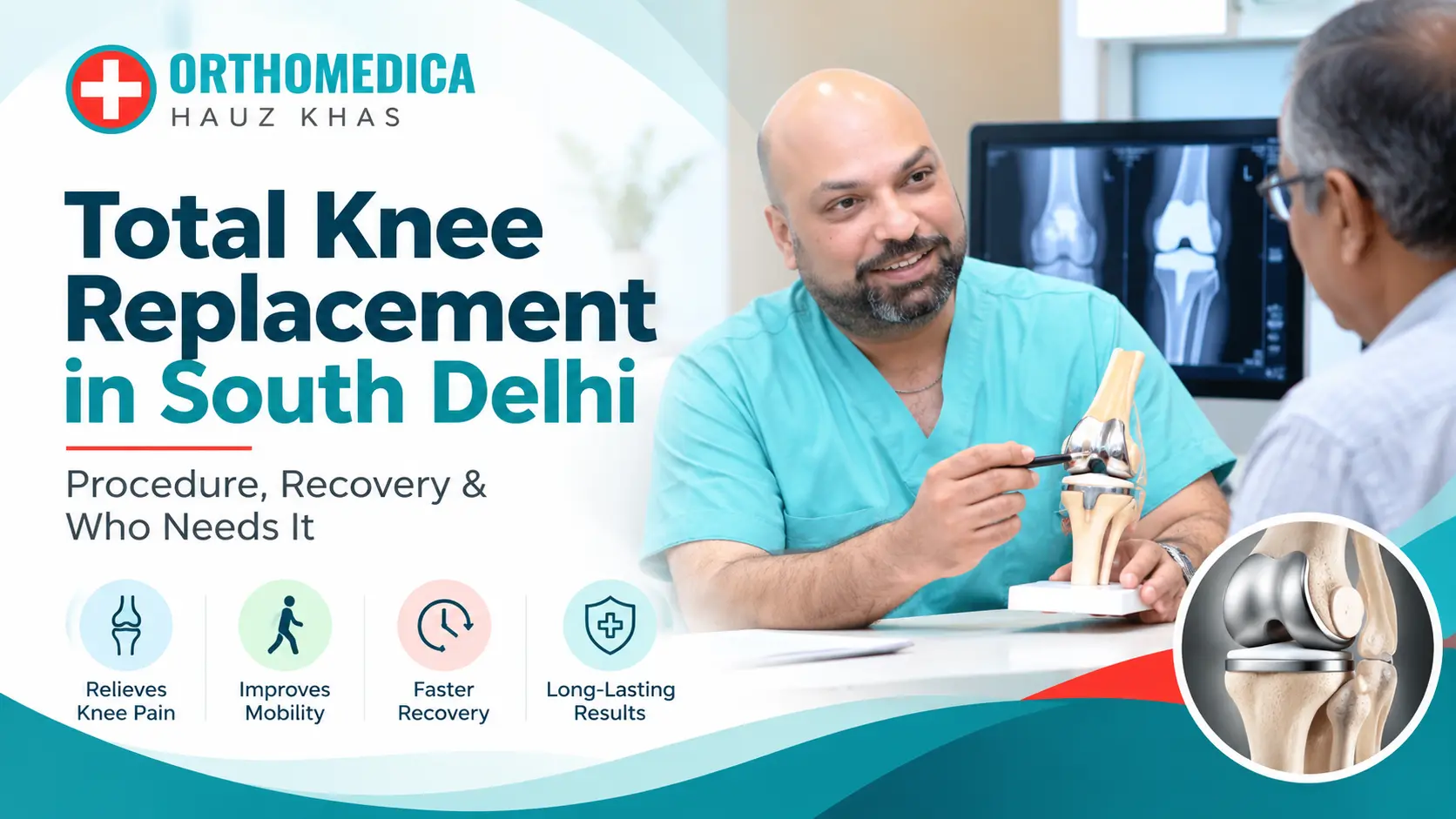
Learn about total knee replacement, recovery and treatment considerations at OrthoMedica, Hauz Khas
Total Knee Replacement in South Delhi: Procedure, Recovery & Who Needs It
By Dr. Abhishek Kumar Mishra, Senior Consultant, Joint Replacement, Orthopaedics and Spine (MBBS MAMC, MS Ortho, MCh Ortho), OrthoMedica, Hauz Khas. Last updated: 24 October 2026.
Ask a patient with severe knee arthritis what they fear most and the answer is rarely the operation. It is the unknown: how long will I be in hospital, will I walk properly again, what if it doesn’t work? A clear picture of what total knee replacement involves takes away most of that fear.
Here is a plain, step-by-step explanation for anyone in Hauz Khas, Saket, Vasant Kunj, Greater Kailash, Lajpat Nagar or elsewhere in South Delhi.
Quick answer: Total knee replacement (TKR) is an operation in which the damaged surfaces of the thigh bone, shin bone and often the kneecap are removed and replaced with a smooth metal and medical-grade plastic implant. It is done for advanced arthritis when pain, stiffness and deformity limit normal life and non-surgical treatment has stopped working. Most patients walk with support the next day and get steady relief over the following months.
Total knee replacement at a glance
| Who needs it | People with advanced knee arthritis or joint damage not helped by non-surgical care |
| Surgery time | Roughly 1 to 2 hours per knee |
| Anaesthesia | Usually spinal; sometimes general |
| First steps | Usually within a day, with a walker |
| Daily routine | Often back in about 4 to 6 weeks |
| Long-term | About 82% of knee replacements last 25 years in a Lancet analysis |
What exactly is replaced in a total knee replacement?
The knee is a hinge made of three bones, covered by smooth cartilage. In arthritis, that cartilage wears away and bone rubs on bone. The surgeon trims a thin layer of damaged bone from the end of the femur (thigh bone) and the top of the tibia (shin bone), and fits metal components. A medical-grade plastic spacer between them acts as the new cartilage. The kneecap surface may also be resurfaced.
“Total” simply means all main weight-bearing parts of the joint are resurfaced, as opposed to a partial knee replacement, where only one damaged compartment is replaced.
Is it time? Signs you may need TKR
- Daily pain when walking, using stairs or standing up from a chair
- Night pain that wakes you up
- A knee that is swollen, stiff or gives way
- Visible bowing of the legs
- Walking distance shrinking month by month
- No lasting relief from medicines, exercise, weight loss or injections over several months
Not all knee pain needs replacement. Early arthritis can often be managed without surgery. Read about arthritis symptoms and treatment options and our arthritis care in Delhi.
The step-by-step journey
- Consultation: the surgeon examines your knee, checks alignment and looks at your X-rays.
- Fitness checks: blood tests, ECG and a review of your sugar, blood pressure and medicines.
- Planning: implant size and alignment are planned from your measurements. Know more about our knee replacement approach.
- Surgery: damaged surfaces are removed, the implant is fitted, and the knee is tested for balance and movement before closing.
- Same-day or next-day mobilisation: you are helped to stand and take first steps.
- Physiotherapy: exercises start early and continue for weeks. This is the part that decides how good your knee will feel.
Recovery timeline you can plan around
- Hospital: a few days, depending on your health and progress
- Weeks 1 to 2: walker, swelling control, bending exercises
- Weeks 4 to 6: daily tasks, and for many, desk work
- Months 3 to 6: walking without support, stronger muscles, better stairs
- Up to 12 months: gradual final improvements in strength and comfort
Practical tip: set up your home before surgery. Keep a firm chair with arms, a raised toilet seat if needed, non-slip mats and a clear path from the bed to the bathroom. If you use an Indian-style toilet or sit cross-legged for prayer, discuss this with your surgeon in advance so your recovery plan fits your life.
Risks and how they are reduced
TKR is a well-established operation, but you should know the risks: infection, blood clots, stiffness, persistent pain, implant loosening over time and, rarely, nerve or vessel injury. Clean operating-room protocols, blood-thinning where required, early walking and good wound care lower these risks. Diabetes and blood pressure need good control before surgery.
How long will the implant last?
A 2019 systematic review and meta-analysis in The Lancet reported that around 82% of total knee replacements were still functioning after 25 years (study summary). Maintaining a healthy weight and doing your exercises help protect the implant.
Total knee replacement vs other options
- Physiotherapy and weight loss: first-line for early to moderate arthritis
- Injections: can give temporary relief in selected cases
- Arthroscopy: helps mechanical problems like meniscus tears, not advanced arthritis. See arthroscopic surgery.
- Partial replacement: for damage limited to one compartment
- Total replacement: for advanced damage across the joint
If your problem is in the hip rather than the knee, read about hip replacement and joint replacement surgery in Delhi.
What affects the cost of TKR in South Delhi?
No honest surgeon can quote a final figure without examining you. Cost depends on the hospital and room category, implant type, one or both knees, technology used, length of stay, and insurance. Ask for an itemised written estimate.
Consult Dr. Abhishek Kumar Mishra at OrthoMedica, Hauz Khas
Dr. Abhishek Kumar Mishra is a senior consultant in joint replacement, orthopaedics and spine (MBBS from MAMC, MS Ortho, MCh Ortho), with a focus on hip and knee replacement, arthroscopy, sports injuries and joint preservation. OrthoMedica is at D-40, near E Block Market, Hauz Khas Market, Kharera, New Delhi 110016, open every day from 9 AM to 5 PM. Read about the doctor and clinic, watch our patient videos, explore a case study, or read more on why patients seek a knee replacement surgeon in South Delhi and about knee replacement surgery in Delhi.
Frequently asked questions
What is total knee replacement?
It is surgery that replaces the worn surfaces of the thigh bone, shin bone and often the kneecap with a metal and plastic implant to reduce pain and restore movement.
Who is a good candidate for total knee replacement?
Adults with advanced knee arthritis whose daily life is limited by pain and stiffness, and who have not improved with several months of non-surgical treatment.
Is total knee replacement painful?
There is pain after surgery, but modern anaesthesia, nerve blocks and structured pain control keep it manageable. Most people feel the long-term pain is much better.
How long does recovery take?
Walking with support starts within a day, daily tasks return in about 4 to 6 weeks and full strength may take several months to a year.
How long does a knee replacement last?
About 82% of knee replacements last 25 years according to a Lancet systematic review, depending on your weight, activity and rehabilitation.
Can both knees be done together?
In selected fit patients, yes. Your surgeon will decide after assessing your heart, lungs and overall strength.
When can I climb stairs and drive?
Many patients manage stairs with support in a few weeks. Driving depends on which knee was operated and your surgeon’s clearance, often around 4 to 6 weeks.
How do I book a consultation?
Use the appointment page or call +91 99994 81645.
Ready to talk about your knee? Book an appointment at OrthoMedica, Hauz Khas. You will get an honest opinion on whether surgery is the right step for you.
Sources: Evans JT et al., “How long does a knee replacement last? A systematic review and meta-analysis,” The Lancet, 2019;393:655-663.
Disclaimer: This article is for general education and does not replace a medical examination. Please consult a qualified doctor for diagnosis and treatment.