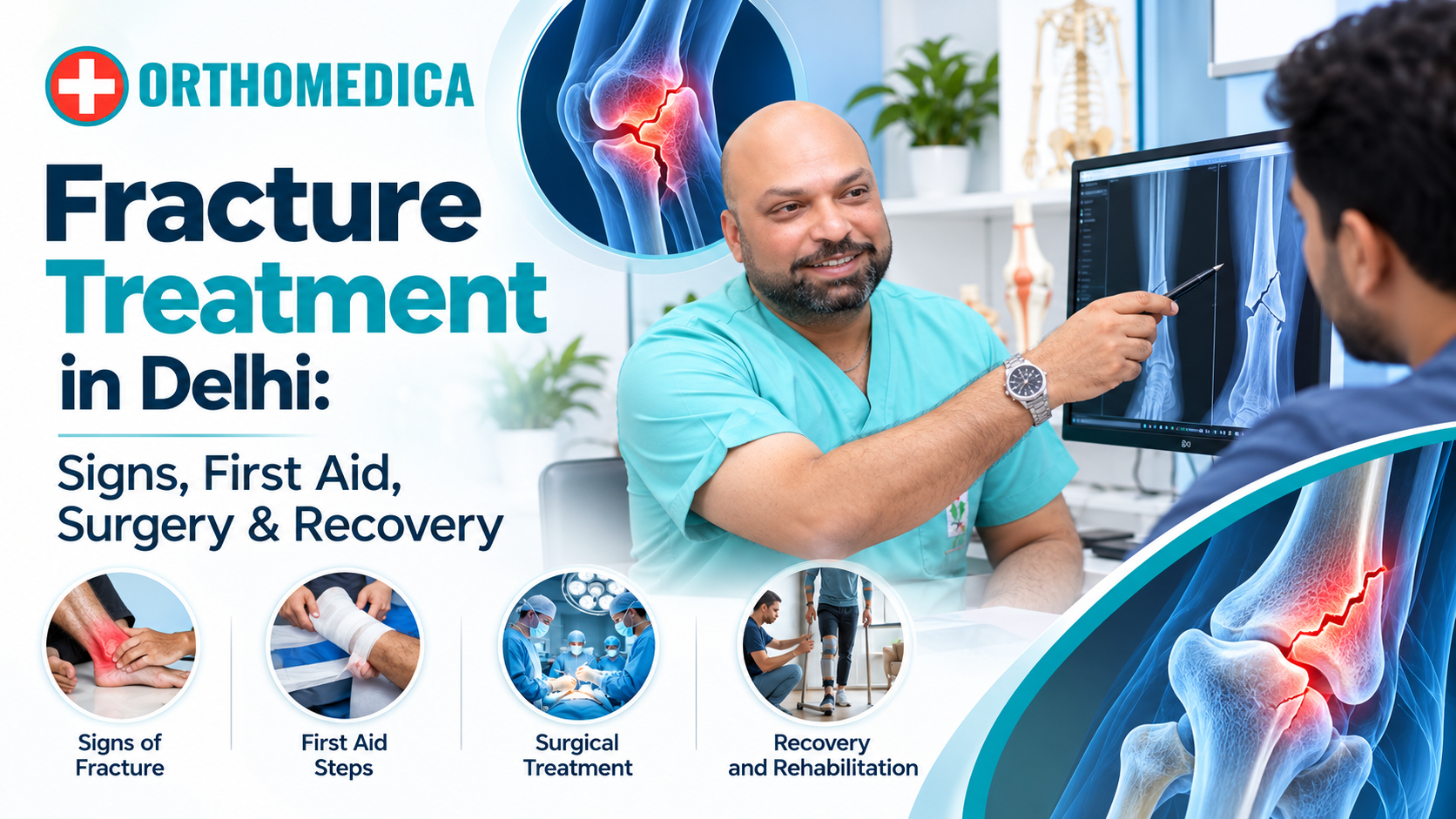
Fracture Treatment in Delhi: Signs, First Aid, Surgery & Recovery
A fall on a wet bathroom floor, a bike skid on the way to work, a bad landing on the football field. In a second, you feel a sharp pain and your first thought is: is it broken? Knowing what a fracture looks like, what to do in the first hour and when surgery is needed can make recovery faster and safer. This guide explains fracture treatment in Delhi in simple language.
Quick answer: A fracture is a crack or break in a bone. Signs include severe pain, swelling, bruising, deformity and inability to use the limb. First aid is to keep the injured part still, support it and get an X-ray quickly. Many fractures heal with a cast or splint, while displaced or unstable ones may need surgery with plates, screws or rods. Most take 6 to 12 weeks to heal, depending on the bone.
Signs that a bone may be broken
- Sudden, sharp pain that gets worse when you move or press the area
- Swelling and bruising within minutes to hours
- A bent, twisted or visibly odd-shaped limb
- A grinding or snapping sensation at the time of injury
- Inability to bear weight or move the joint
- Numbness or tingling below the injury
Some fractures, such as hairline or stress fractures, cause only a dull, persistent ache. If pain does not settle in a few days after an injury, get it checked.
First aid: what to do right away
- Do not try to straighten the bone. Keep the limb in the position you found it.
- Immobilise. Support it with a splint, folded cloth or a firm board, including the joints above and below.
- Control bleeding with clean cloth pressure if there is a wound.
- Apply a cold pack, wrapped in cloth, to reduce swelling. Never place ice directly on skin.
- Avoid food and drink if you may need surgery, until a doctor advises.
- Get medical help and an X-ray as soon as possible.
Go to the nearest emergency room immediately if bone is visible through the skin, the limb is cold, pale or numb, there is heavy bleeding, or the injury involves the head, neck, back, pelvis or thigh.
Common types of fractures
- Closed fracture: the bone breaks but the skin stays intact.
- Open (compound) fracture: the bone pierces the skin. This is an emergency because infection risk is high.
- Hairline or stress fracture: a thin crack, often from repeated strain.
- Displaced fracture: the broken ends have moved out of line.
- Comminuted fracture: the bone breaks into several pieces.
How doctors diagnose a fracture
The orthopaedic surgeon will examine the injury and check blood flow and nerve function. An X-ray usually confirms the break. For complex injuries around joints, a CT scan or MRI may be needed to see the exact pattern or any ligament damage.
Fracture treatment: cast, surgery or both?
Non-surgical treatment
Stable fractures where the bone ends are well aligned are often treated with a plaster cast, splint or brace, along with pain control and follow-up X-rays.
Surgical treatment
Surgery is advised when the bone is displaced, unstable, open, involves a joint surface, or has not healed well. The surgeon realigns the bone and holds it with plates and screws, intramedullary nails or, in some cases, an external fixator. The aim is a bone that is straight, stable and ready for early movement.
In older adults, hip fractures usually need surgery soon after injury so that the person can sit up and walk early, which lowers the risk of complications.
How long does a fracture take to heal?
Healing time varies with the bone, the type of break, your age and general health. As a general guide:
- Fingers, wrist and forearm: roughly 6 to 8 weeks
- Ankle and lower leg: roughly 8 to 12 weeks
- Thigh bone and hip: often 3 to 6 months, sometimes longer
Smoking, diabetes, low vitamin D, poor nutrition and osteoporosis can slow healing. Calcium, protein and vitamin D support recovery, but follow your doctor’s advice on supplements.
Recovery tips that really help
- Follow cast and weight-bearing instructions exactly
- Keep the limb elevated to control swelling
- Move the fingers or toes you are allowed to move
- Do not skip physiotherapy once the doctor clears it, since stiffness is a common cause of poor recovery
- Report increasing pain, fever, discharge or numbness at once
Fracture and trauma care with Dr. Abhishek Kumar Mishra, Hauz Khas
Dr. Abhishek Kumar Mishra is a senior orthopaedic consultant (MBBS from M
AMC, MS Ortho, MCh Ortho) with experience in joint replacement, arthroscopy, sports injuries and spine care. OrthoMedica clinic is in Hauz Khas, South Delhi, and is open every day from 9 AM to 5 PM. Read more about our fracture and trauma care.
Fractures often leave behind joint problems. If an old injury still troubles you, our guides on sports injury treatment, arthritis symptoms and options and joint replacement surgery in Delhi may help. You can also learn about the clinic and read other articles on our blog.
Frequently asked questions
How do I know if it is a sprain or a fracture?
Both cause pain and swelling. A fracture usually causes severe pain, trouble bearing weight, visible deformity or pain when you gently press the bone. Only an X-ray can tell for sure.
Can a fracture heal without
treatment?
Bones can start healing on their own, but without proper alignment and support they may heal crooked, stay painful or not unite at all. Always have it examined.
Is surgery always needed for a fracture?
No. Many stable fractures heal well with a cast or splint. Surgery is for unstable, displaced, open or joint-involving fractures.
How soon should I see a doctor after a fracture?
As soon as possible, ideally within hours. Early care reduces pain and complication risk.
When can I walk after a leg fracture?
It depends on the bone and the treatment. Your surgeon will tell you when to put weight on the leg, so do not rush it.
Do fractures cause arthritis later?
Fractures that involve a joint surface can raise the chance of arthritis years later, which is why accurate realignment matters.
How do I book an appointment?
Use the appointment page or call +91 99994 81645.
Injured and unsure if it is serious? Book an appointment at OrthoMedica, Hauz Khas. For severe injuries, go to the nearest emergency department first.
Disclaimer: This article is for general information and does not replace medical advice. In an emergency, seek immediate care.