
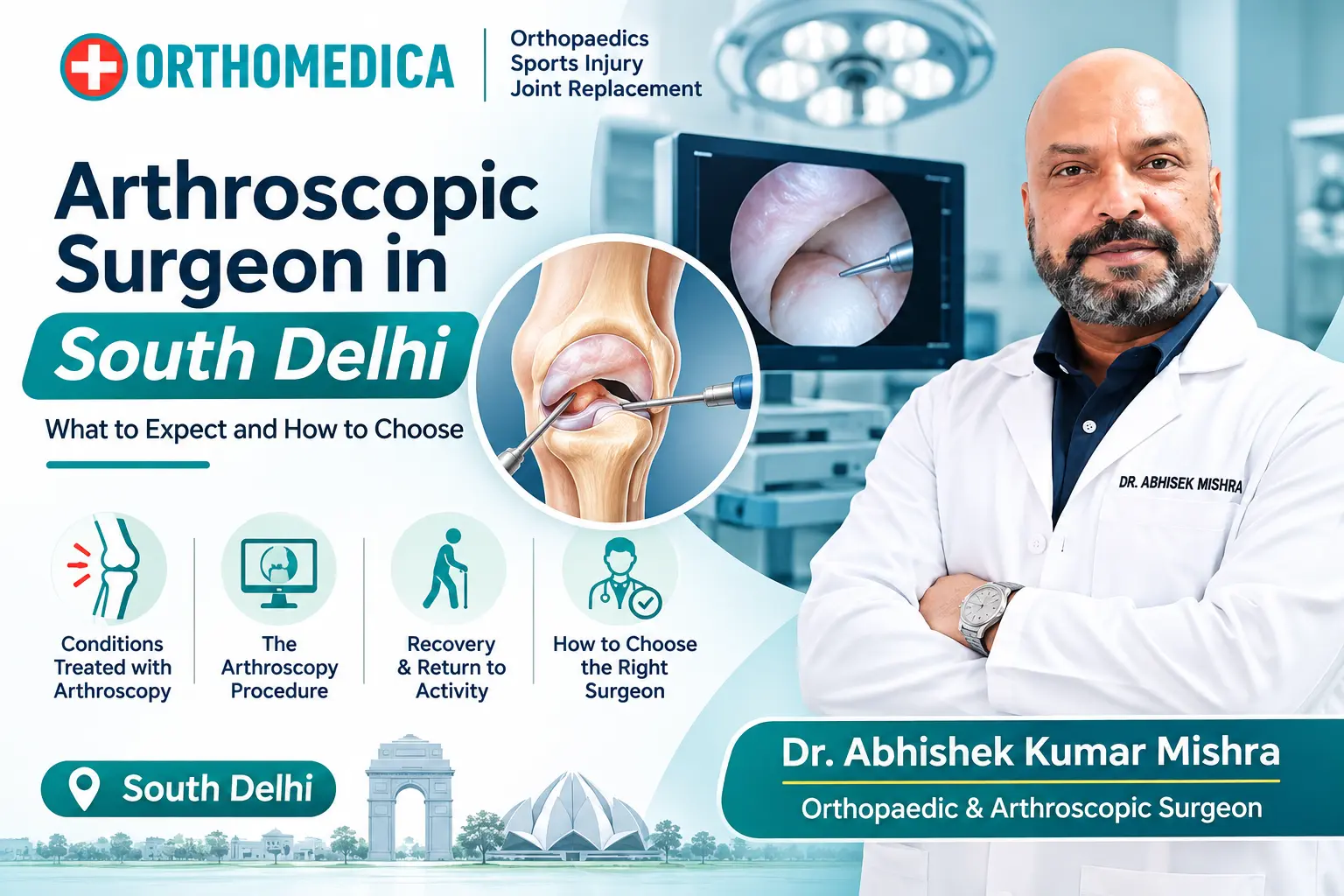
Learn about knee arthroscopy, treatment options and recovery with Dr. Abhishek Kumar Mishra at OrthoMedica.
Arthroscopic Surgeon in South Delhi: What to Expect and How to Choose
By Dr. Abhishek Kumar Mishra, Senior Consultant, Joint Replacement, Orthopaedics and Spine (MBBS MAMC, MS Ortho, MCh Ortho), OrthoMedica, Hauz Khas. Last updated: 6 November 2026.
Think of a twisted knee on the football ground. Or a shoulder that clicks and catches when you lift your arm. Maybe it is a hip that pinches every time you sit cross-legged. Many such problems need more than a scan and a pain tablet. Sometimes the surgeon needs to look inside the joint itself. If you are searching for an arthroscopic surgeon in South Delhi, this guide explains what arthroscopy is, what it can fix, what it cannot, and how to choose well.
Quick answer: An arthroscopic surgeon repairs joint problems through small cuts, using a thin camera and fine instruments. The right surgeon is a trained orthopedic surgeon who examines you first, explains whether you need surgery at all, and plans your rehabilitation. Dr. Abhishek Kumar Mishra (MBBS, MS Ortho, MCh Ortho) consults at OrthoMedica in Hauz Khas, every day from 9 AM to 5 PM, and arthroscopy is one of his listed areas of practice.
What is arthroscopy?
The word means “looking inside the joint”. The surgeon makes a few small cuts, each about the size of a buttonhole. Then a thin camera goes in, and the picture appears on a screen. Fine instruments pass through the other cuts to repair the damage. According to the Mayo Clinic, surgeons use it most often in the knee, shoulder, elbow, ankle, hip and wrist.
Because the cuts are small, patients often have less pain and a quicker start to rehabilitation than with open surgery. Our page on arthroscopic surgery explains the basics.
Which problems can arthroscopy treat?
OrthoMedica lists these conditions under arthroscopy:
- Knee: meniscus tears, ACL injuries and cartilage damage
- Shoulder: rotator cuff tears, impingement and labral tears
- Hip: femoroacetabular impingement (FAI) and hip labral tears
- Elbow and wrist: tennis elbow and ligament injuries
Not every problem fits here. Severe arthritis, for example, often needs a different plan. Read our guide to arthritis symptoms and options, or see knee replacement when the joint is badly worn.
Signs you may need an arthroscopic surgeon
- Knee pain after a twist, with swelling or catching
- A knee that locks or gives way
- Shoulder pain at night or weakness when lifting the arm
- Groin pain in the hip, especially when you sit or squat
- Pain that has not improved with rest and physiotherapy
However, these signs can have simple causes too. So, get a proper examination before you decide on surgery.
Arthroscopic surgeon in South Delhi: how to choose one
Choosing a surgeon is not about the biggest advertisement. Instead, check these points:
- Training. Look for orthopedic qualifications and arthroscopy experience. Ask where the surgeon trained.
- A real examination. The surgeon should test movement and stability, and review your MRI with you.
- Honest advice. A good surgeon tells you when physiotherapy or injections can come first.
- Clear explanation. You should know what will be repaired, and what recovery looks like.
- A rehabilitation plan. Surgery is half the job. Exercises complete it.
- Open talk about risks. Infection, stiffness and clots are rare, but you should hear about them.
Beware of anyone who promises a perfect result. Nobody can.
What happens before surgery?
First, the surgeon takes your history and examines the joint. Next, you may need an X-ray or MRI. Then the team checks your general health, including blood tests and any medicines you take. You also learn the type of anesthesia. The Mayo Clinic notes that it can be local, regional or general, depending on the joint and the procedure.
What happens during surgery?
OrthoMedica describes arthroscopy as a procedure lasting about 30 to 90 minutes. The surgeon first inspects the whole joint through the camera. After that, the repair begins. For example, a torn meniscus may be trimmed or stitched, and a torn ACL may be rebuilt with a graft. The exact steps depend on your diagnosis.
Recovery after arthroscopy
Recovery differs with each joint and each repair. Still, the general pattern is similar.
- Day one: you rest for a few hours, and most patients go home the same day or soon after
- First days: mild swelling is common, so use ice, elevation and prescribed medicines
- First weeks: physiotherapy starts, and you may use crutches or a sling for some time
- Desk work: many people return within days to a few weeks
- Sport: this takes longer, and your surgeon decides when it is safe
Rushing is the most common mistake. A repaired tissue needs time to heal, even when the pain has gone. Therefore, follow your physiotherapist’s plan closely. See our page on sports injury treatment for return-to-sport guidance.
Risks you should know about
Arthroscopy is considered a safe procedure, and complications are uncommon. Even so, risks exist. These include infection, tissue or nerve injury and, rarely, blood clots. Call your surgeon at once if you have fever, drainage from the wound, severe pain, or new numbness.
Arthroscopy or open surgery?
Many problems can be repaired through small cuts. Yet some injuries, such as complex fractures or advanced joint damage, need open surgery or replacement. A good surgeon chooses the method that suits the problem, not the other way round. For fractures, see fracture and trauma care.
Questions to ask your arthroscopic surgeon in South Delhi
- What exactly is damaged in my joint, and can I see the MRI?
- Can I try physiotherapy first, and for how long?
- Will you repair or remove the damaged tissue?
- When can I walk, drive and return to work?
About Dr. Abhishek Kumar Mishra
Dr. Abhishek Kumar Mishra is a senior consultant in joint replacement, orthopedics and spine. He completed his MBBS at Maulana Azad Medical College (MAMC), followed by an MS and an MCh in orthopedics. His focus areas include arthroscopy, sports injuries, hip and knee replacement, spine surgery, and arthritis care. Ask him directly how often he performs the procedure you need, and what recovery to expect in your case.
See what real patients say on the patient video page, read a case study or learn more on the about page.
Related guides
Comparing doctors? Read our posts on the best orthopedic doctor in South Delhi and a trusted joint replacement surgeon in South Delhi.
Clinic location and timings
OrthoMedica is at D-40, near E Block Market, Hauz Khas Market, Kharera, New Delhi 110016. The clinic is open every day from 9 AM to 5 PM. Patients also visit from Saket, Green Park, Safdarjung Enclave and Vasant Kunj.
Frequently asked questions
Who is the best arthroscopic surgeon in South Delhi?
Look for orthopedic training, arthroscopy experience, a careful examination and honest advice. Meet the surgeon and ask about experience before you decide.
Is arthroscopy a major surgery?
It uses small cuts and is considered safe, but it is still surgery. It needs anesthesia and a proper rehabilitation plan.
How long does arthroscopy take?
OrthoMedica describes it as about 30 to 90 minutes, depending on what needs repair.
How long is recovery after knee arthroscopy?
Light activity often resumes within days to a few weeks. Full recovery and sport take longer and depend on the repair.
Can arthroscopy cure arthritis?
No. It can address certain mechanical problems, but worn-out joint surfaces usually need other treatment. Your surgeon will advise after examination.
What are the clinic timings?
OrthoMedica in Hauz Khas is open every day from 9 AM to 5 PM.
How do I book an appointment?
Use the appointment page or call +91 99994 81645.
Joint pain that will not settle? Book an appointment at OrthoMedica, Hauz Khas.