
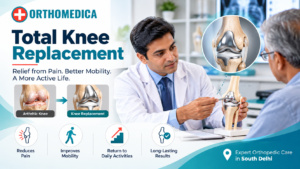
Total Knee Replacement: Procedure, Benefits and Recovery
Knee pain can gradually affect everyday activities such as walking, climbing stairs, standing for long periods and getting up from a chair. One common cause of persistent knee pain is osteoarthritis, a condition in which the protective cartilage inside the joint gradually wears down.
When medication, physiotherapy and other appropriate treatments no longer provide sufficient relief, total knee replacement may be considered. Understanding the procedure, recovery process and available treatment options can help patients make informed healthcare decisions.
If you are searching for a knee replacement surgeon in South Delhi, it is important to understand when surgery may be appropriate and how an orthopaedic specialist evaluates your condition.
What Is Total Knee Replacement?
Total knee replacement (TKR), also called total knee arthroplasty, is a surgical procedure in which damaged joint surfaces are replaced with artificial components. It is commonly considered for people with advanced knee arthritis and significant pain or functional limitations.
The aim is to reduce pain and improve the ability to perform everyday activities. The procedure does not guarantee complete pain relief or identical results for every patient.
A qualified orthopaedic surgeon evaluates the severity of joint damage, symptoms, general health and treatment history before recommending surgery.
What Are the Signs You May Need Knee Replacement?
Not everyone with knee pain requires surgery. However, an orthopaedic assessment may be helpful if you experience:
- Persistent knee pain that interferes with daily activities
- Stiffness, particularly after resting or in the morning
- Difficulty walking or climbing stairs
- Swelling around the knee joint
- Reduced knee movement
- Pain that continues despite appropriate non-surgical treatment
- Difficulty sleeping because of knee discomfort
These symptoms can have different causes. A clinical examination and appropriate investigations help determine whether knee arthritis or another condition is responsible.
Not everyone with knee pain requires surgery. However, an orthopaedic assessment may be helpful if you experience:
- Persistent knee pain that interferes with daily activities
- Stiffness, particularly after resting or in the morning
- Difficulty walking or climbing stairs
- Swelling around the knee joint
- Reduced knee movement
- Pain that continues despite appropriate non-surgical treatment
- Difficulty sleeping because of knee discomfort
These symptoms can have different causes. A clinical examination and appropriate investigations help determine whether knee arthritis or another condition is responsible.
When Is Total Knee Replacement Recommended?
A doctor may consider total knee replacement when arthritis has significantly damaged the joint and other suitable treatments have not provided adequate relief.
Treatment options may include activity modification, physiotherapy, weight management where appropriate and medication prescribed by a clinician.
For some patients, joint-preserving treatments may be appropriate. Others with advanced joint damage may benefit from replacement surgery.
You can also learn about the different approaches to arthritis treatment at OrthoMedica, including treatment options that may be considered before joint replacement.
The decision to undergo surgery should be based on your symptoms, examination findings, imaging and personal goals—not an X-ray alone.
How Is Total Knee Replacement Performed?
During total knee replacement, the surgeon removes damaged cartilage and a small amount of underlying bone from the affected joint surfaces. Artificial components are then positioned to restore the joint’s function.
The procedure generally involves the following stages:
- Pre-operative assessment: The medical team reviews your health, medications, investigations and suitability for surgery.
- Anaesthesia: The anaesthesia team determines the appropriate anaesthetic approach.
- Joint preparation: Damaged joint surfaces are prepared for the replacement components.
- Implant placement: Artificial components are positioned to provide a functioning joint.
- Post-operative care: Pain management, early mobilisation and rehabilitation begin according to the clinical plan.
The exact technique and implant selection depend on the patient’s anatomy, joint condition and the surgeon’s assessment.
What Is the Difference Between Total and Partial Knee Replacement?
Total knee replacement involves replacing the damaged joint surfaces across the knee, while partial knee replacement addresses only the affected compartment in appropriately selected patients.
A partial replacement may preserve more of the natural joint, but it is not suitable for everyone. The choice depends on the location and extent of arthritis, ligament function and other clinical factors.
Your surgeon can explain which approach is appropriate after evaluating your knee.
What Is Recovery Like After Knee Replacement Surgery?
Recovery varies according to general health, muscle strength, the type of procedure and individual healing.
Rehabilitation commonly includes:
- Getting out of bed and walking with assistance when medically appropriate
- Physiotherapy to improve knee movement
- Exercises to strengthen the muscles around the joint
- Gradual progression towards everyday activities
- Follow-up appointments to monitor recovery
Many patients resume basic daily activities progressively over the first several weeks, although complete recovery can take several months.
Following your rehabilitation plan is important. Contact your medical team if you experience unexpected worsening pain, fever, wound discharge or significant swelling.
How to Choose an Orthopedic Surgeon in South Delhi
When searching for an orthopedic surgeon in South Delhi, consider the doctor’s qualifications, experience with joint replacement, approach to diagnosis and access to post-operative rehabilitation.
Patients looking for the best orthopedic doctor in South Delhi should also consider whether the recommended treatment is appropriate for their condition and whether the risks, benefits and alternatives have been explained clearly.
For people searching for a bone specialist in South Delhi or the best bone and joint specialist in South Delhi, a consultation can help distinguish arthritis from other causes of knee pain.
Dr. Abhishek Kumar Mishra is listed on the OrthoMedica website as a senior orthopaedic and joint replacement surgeon. The clinic is located at D-40, near E Block Market, Hauz Khas Market, New Delhi.
Explore the OrthoMedica website to learn more about the clinic and its orthopaedic services. You can also read the doctor’s professional profile before enquiring about an appointment.
Frequently Asked Questions
1. When should I consider total knee replacement?
It may be considered when advanced knee arthritis causes significant pain or disability and appropriate non-surgical treatments no longer provide sufficient relief. An orthopaedic evaluation is necessary before making this decision.
2. Is total knee replacement a major surgery?
Yes. It is a major orthopaedic operation that requires pre-operative assessment, anaesthesia, post-operative care and rehabilitation. The potential risks and expected benefits should be discussed with your treating team.
3. How long does it take to recover after knee replacement?
Recovery differs between patients. Many people gradually resume basic daily activities over several weeks, while strength, mobility and overall recovery may continue improving for several months.
4. Can I walk normally after knee replacement?
Many patients experience improved mobility after recovery, but results vary. Rehabilitation, the condition of the joint and overall health can influence walking ability.
5. Who should I consult for knee replacement in Hauz Khas?
Consult a qualified orthopaedic or joint replacement surgeon who can assess your symptoms, review investigations and explain whether surgery is suitable. Confirm the clinic’s appointment availability before visiting.
Conclusion
Total knee replacement may help people with advanced knee arthritis reduce pain and improve mobility when other suitable treatments have not provided sufficient relief. Understanding the procedure, alternatives and rehabilitation requirements is an important part of making an informed decision.
If persistent knee pain is affecting your daily life, consider consulting an orthopaedic specialist for an individual assessment and treatment plan.
This article is for general educational purposes and does not replace professional medical advice.